Cancel a booking with a tiered refund
Written by youDevit Agents AI-assisted development, with a person on the merge button
Ticket in.Reviewed PR out.
Write the ticket on your Trello board. Our agents analyze it against your code, build it and review it. A person merges and tests every change. You get steady fixes and small features without hiring an in-house development team.
Works with Trello today. Jira and GitHub Projects on request.
- Agent lanes run on their own, every five minutes.
- Your lanes wait for you.
- A vague ticket stops in Needs Clarification with questions. It never reaches Doing.
Backlog You
TKT-218Export bookings to CSV for the accountant
To Do You
Analysis Agent
Ready for Dev Queue
TKT-214Show the admin fee on the booking summary
Doing Agent
Code Review Agent
Ready to Merge You
Testing You
TKT-209 · PR #39Session timer keeps counting after the call ends
Done
TKT-205 · PR #37Add title and surname to registration forms
The board is the whole process. Every move is logged as a comment on the card, so you can read the history without leaving your board.
01Who it's for
A live product and nobody to work the backlog.
Or a new product that needs building. The loop works the same for new and existing projects, with or without a tech team of your own.
Founders past launch
The agency that built your app has moved on. The backlog keeps growing. You need steady fixes and small features.
Small businesses with software at the core
A booking system, a marketplace, a members portal. It earns money every day and you can't justify a full-time developer to keep it moving. Nobody to merge and test? On the Managed option we do that for you, and you sign off.
Agencies with overflow
Maintenance retainers that eat senior time. Hand the loop to us and keep the client relationship, the review, and the margin.
02How a ticket moves
Nine lanes on the main path. Agents work three. Every decision is yours.
Everything starts in the backlog Backlog · You
Bugs, ideas and requests from your team land here. Nothing is worked on until you pick it, so you set the priorities and the pace.
You pick the card To Do · You
A title and a few lines is enough. Acceptance criteria help, but most tickets don't have them; that is what the next lane is for.
The analyst reads it against your code Analysis · Agent
It posts an Implementation Brief on the card: numbered, testable criteria, the files involved, an approach, risks, a size (S, M or L) and a manual test plan written for a non-developer. If two competent developers would build different things, the card goes to Needs Clarification with up to five specific questions instead.
- Implementation Brief
- or questions on the card
It waits with its brief Ready for Dev · Queue
One ticket is in flight at a time. The card sits here with its brief until Doing is clear, so nothing is half-built in parallel and branches never collide.
The developer builds it Doing · Agent
On a feature branch, following the brief and your codebase's own conventions. The result is a pull request against your integration branch.
- Pull request with the criteria checked off
The reviewer checks it Code Review · Agent
Security first (injection, XSS, auth bypass), then logic, validation and breaking changes. The review ends with one status line. Changes Recommended sends the card back to Doing automatically; the loop runs until the status reads Looks Good.
- Review comment on the card and the PR
- A message when it's ready for you
You review and merge Ready to Merge · You
Once the review reads Looks Good, the card waits here for you. Read the pull request and the review, then merge it into your integration branch. Agents never merge. On the Managed option a Devit engineer takes this step, and the next, for you.
You test it Testing · You
Deploy to your test environment and follow the test plan from the brief. Found a problem? Add a note and drag the card back to Doing. The developer picks it up with your note.
You decide when it ships Done
Promotion to production stays a human decision, on your schedule.
03Updates as it moves
You hear about every move. And every problem.
Each time a ticket changes lane, a short message lands where your team already talks: Slack, WhatsApp or email. If the workflow itself runs into trouble, you get an alert, and another when it recovers.
- New tickets, questions and approved reviews as they happen.
- Workflow alerts after three failed cycles in a row, such as an expired GitHub token, so a blip doesn't wake anyone.
New development ticket
TKT-212 · Cancel a booking with a tiered refund. Assigned to the developer agent.
Questions on TKT-216
Three questions need an answer before it can be built. They're on the card.
Code review approved
PR #41: feat(bookings): cancel with tiered refund. Ready for your review and merge.
Workflow alert
Three failed cycles in a row. GitHub rejected the access token.
Workflow recovered
Token renewed. The board is moving again.
04Human gates
Autonomous where it's safe. Supervised where it counts.
- Nothing merges without a person. Agents open pull requests and post reviews. They cannot merge, deploy or touch production. The merge button is yours. If nobody on your side can hold it, a Devit engineer holds it for you on the Managed option, and you still decide when it ships.
- Vague tickets stop before any code is written. The analyst's questions land on the card in plain language. Answer them, drag the card back, and it is re-analyzed with your answers. No developer time is spent guessing.
- One ticket in flight. A work-in-progress limit of one keeps branches from colliding and keeps the reviewer's attention on a single change. Testing never blocks the next ticket.
- Everything stays on your board and in your repo. Briefs, reviews and status changes are comments on your cards and your pull requests. There is no second system to log into and nothing to export when you leave.
- Scoped access you can revoke in a minute. A dedicated bot account with a repository-scoped token. No database credentials, no production access. Agents read your schema from the code, never from a live database.
05What lands on the card
One ticket, start to finish.
Every move is logged on the card as a status change or a short comment. The brief and the review are the long ones; the pull request details stay on the PR.
- Agent steps run on their own.
- You steps wait for you.
- also sent to Slack, WhatsApp or email.
Cancel a booking with a tiered refund
DoneYou created the card in Backlog
You moved it to To Do
Analyst agent posted the implementation brief and moved it to Ready for Dev
Implementation brief
Developer agent picked it up and moved it to Doing
Developer agent opened PR #41 and moved it to Code Review
PR #41 opened against
dev. All criteria checked off.Reviewer agent recommended changes and moved it back to Doing
Changes recommended2 issues
route.ts:42readsrefundPctfrom the request body. A client can send 100. Compute it on the server withlib/refunds.ts.CancellationEmail.tsxrenders the cancellation reason withdangerouslySetInnerHTML. Render it as plain text.
The full review is also posted on PR #41.
Developer agent pushed 2 fixes and moved it to Code Review
Reviewer agent approved it and moved it to Ready to Merge
Looks good Both issues fixed. Ready for your merge.
You merged PR #41 and moved it to Testing
You followed the test plan and moved it to Done
06First deployment
Open Air Hub: 120+ tickets, one person merging.
Open Air Hub is a services marketplace with bookings, video sessions and payments. It started on PHP and now runs on Python (FastAPI) and Next.js.

- tickets completed through the workflow
- 120+
- stacks: PHP, then Python (FastAPI) and Next.js
- 2
- ticket in flight at any time
- 1
- minutes between agent checks on the board
- 5
Devit Technology counts City of Cape Town, City of Tshwane, ShopriteX, iXperience, BozaRide, TeeUp, Route Wise and Appstrax among its other clients. The same team built Devit Agents and runs them for you.
07Plans
Start with a pilot. Stay on a retainer.
Pilot and Core are fixed prices. Growth is quoted on your setup. A ticket is one card on the board, sized S, M or L by the analyst. Managed merge and test can be added to any plan.
Pilot
$750 · once-off
Two weeks, up to 5 tickets
See the loop run on your own repository before you commit to anything.
- Board and bot account set up for you
- Analysis, build and review on every ticket
- A written read-out: what shipped, what we'd change
- Updates in Slack, WhatsApp or email
Core Popular
$1,250 / month
Up to 12 tickets a month
A steady stream of fixes and small features for one product.
- One ticket in flight
- Weekly digest: shipped, in review, waiting on you
- Updates and workflow alerts in Slack, WhatsApp or email
- Cancel monthly
Growth
From $2,500 / month
From 13 tickets a month
For a product with a roadmap as well as a backlog.
- Everything in Core
- Choose the AI model for each agent
- Urgent fixes go to the front of the queue
- Fortnightly planning call
Prices in US dollars, excluding VAT. Model usage is included; you never see a per-token bill. Growth is quoted on ticket volume and the models you pick for each agent; the Managed add-on on ticket volume.
Ask about a pilot08Questions
What people ask on the first call.
What do you need from us?
Four things: a Trello board (we set it up from a template; Jira and GitHub Projects on request), a GitHub repository with a bot account invited, somewhere to test a change, and one person who can merge and test. That person spends a few hours a week. Nobody to merge and test? We do it for you on the Managed option. No tech team at all? We can take care of all four.
Do we need our own tech team?
No. On the Managed option we set everything up and run it for you: the board, the repository, the test environment, the merge and the test plan. You write tickets in plain language, try the change on a test site and tell us when it's right. Production still ships on your say-so.
Does it work for new projects, or only existing ones?
Both. For an existing product we connect your repository and the agents follow the conventions already in your code. For a new project we set up the repository and its starting structure with you, then the same loop builds it ticket by ticket.
Which boards do you support?
Trello today. Jira and GitHub Projects on request: we map our lanes to your statuses or columns so your team keeps the board it already uses, and we confirm the setup on the fit call before the pilot starts.
Which stacks do you work in?
Any repository on GitHub can be connected. The loop is framework agnostic: the analyst reads the conventions already in your code and the developer follows them, whatever the language or framework. Our own team works in Node.js, Next.js, Python (FastAPI), Go, React and Angular, with React Native and Flutter on mobile, so that is where we are strongest. PHP is welcome too: Open Air Hub started on PHP (CodeIgniter) before moving to Python (FastAPI) and Next.js. Large compiled monorepos and mobile apps need a call about the build and test setup first.
Who owns the code?
You do. Every change arrives as a pull request in your repository, authored by a bot account you can remove at any time. There is nothing to migrate when you stop.
What happens with a vague ticket?
It stops in Needs Clarification with up to five specific questions, often with options to pick from. Answer on the card, drag it back to To Do, and it is re-analyzed with your answers. Anything the analyst can decide itself, it decides and writes down under Assumptions, so you only answer what matters.
How fast is it?
Analysis lands within minutes of the card reaching To Do. At Open Air Hub, small and medium tickets usually had a reviewed pull request the same working day. Because one ticket is in flight at a time, throughput depends on how quickly you merge and test; the weekly digest shows what is waiting on you.
Which AI models do the agents run?
On Pilot and Core we pick and tune the model for each agent. On Growth you choose the model for the analyst, the developer and the reviewer separately, for example a stronger model for review and a faster one for analysis. Your quote reflects the models you pick.
How is access secured?
A dedicated bot account with a token scoped to your repository, no database credentials and no production access. Agents run on our server, never inside your environment, and read your schema from models and migrations, never from a live database. Every step leaves a comment on a card or a PR, so the audit trail is yours. Model calls go through the Anthropic API, and Anthropic does not use commercial API data to train its models.
What's out of scope?
Product design from a blank page, hosting and 24/7 operations. Testing is yours unless you take the Managed option. Either way the loop ends at a reviewed pull request and you decide when it ships.
09Get in touch
Start with a two-week pilot.
You'll hear back within two working days with a fit-call slot. Send:
- Your stack and where the repository lives.
- A link to your board, or a screenshot of the backlog.
- The first ticket you would want shipped.
- info@devit.technology
- +27 74 581 5475
- Bryanston, Johannesburg
More demos
Other systems you can try.
Computer vision
Meter Reading (AMR)
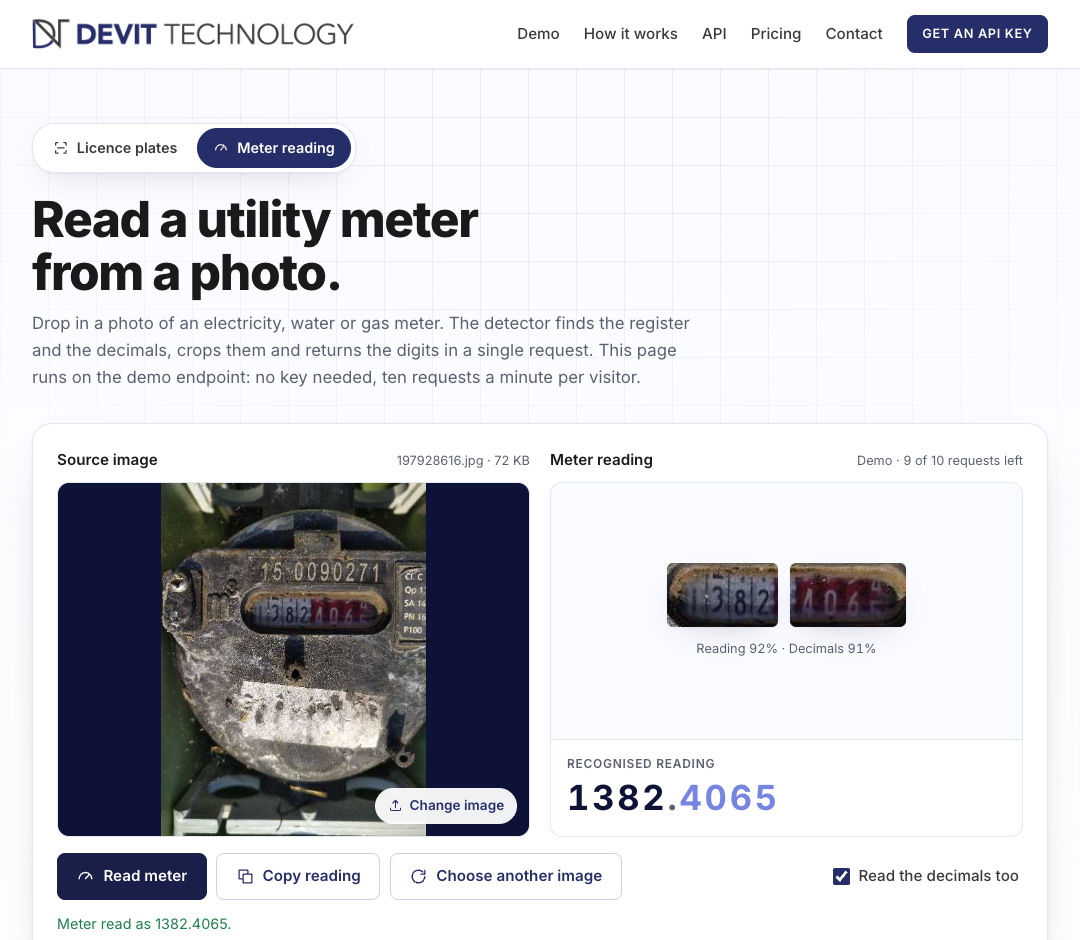
Upload a photo of an electricity, water or gas meter and get the reading back, split into whole units and decimals, with the crops that produced it. The demo endpoint needs no key and allows ten requests a minute per visitor.
Computer vision
Licence Plate OCR
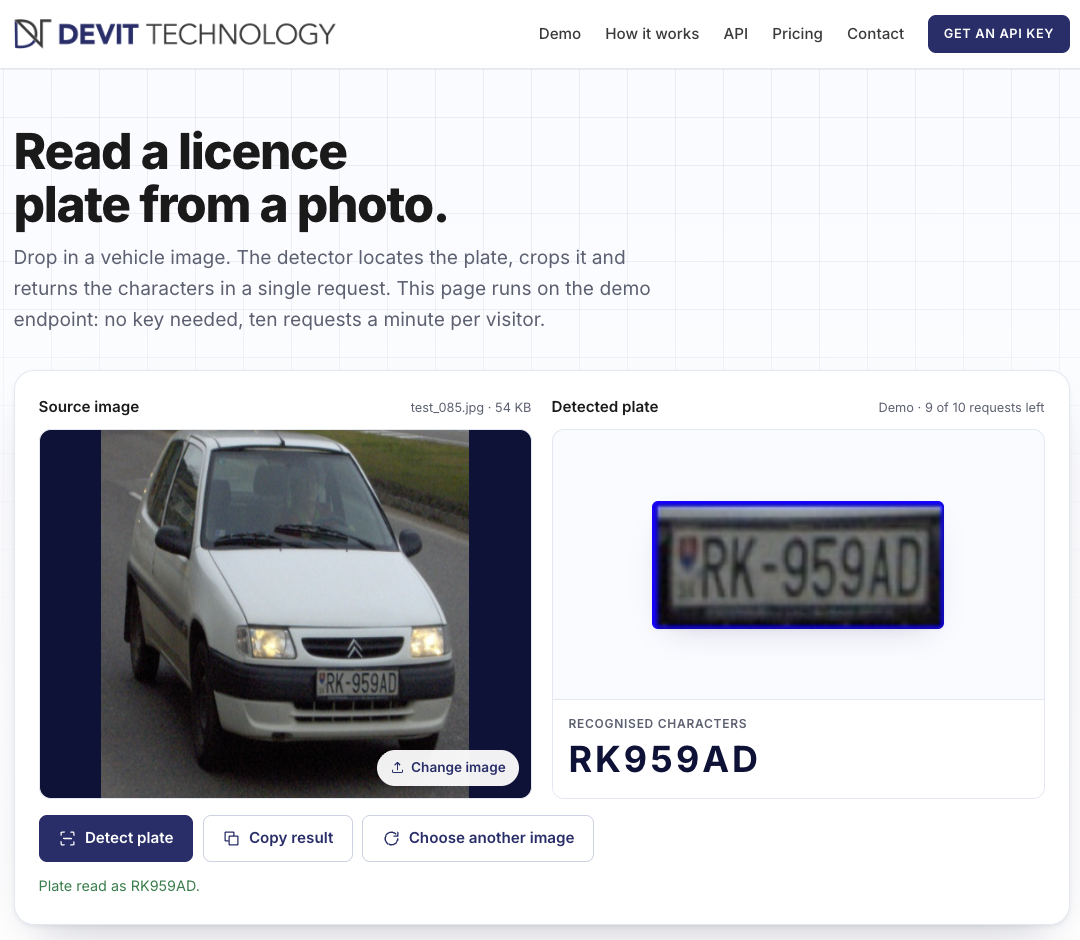
Upload a vehicle photo and get the plate crop and the recognised characters back in one request. The demo endpoint needs no key and allows ten requests a minute per visitor.
ReadySize MConfidence high
Acceptance criteria
Affected areas
app/api/bookings/[id]/cancel/route.ts: new POST handlerlib/refunds.ts: refund tier calculationcomponents/bookings/CancelBookingDialog.tsx: confirm step with a refund previewBooking.cancelledAtandBooking.refundPctin PrismaManual test plan